What TIGTA found
Thirty-eight thousand preparers let their PTIN lapse. The returns kept filing anyway.
Lapsed PTINs still file. Anyone paid to prepare a federal return needs an active Preparer Tax Identification Number, renewed every year. Through October of Processing Year 2025, more than 38,000 preparers with an inactive PTIN prepared more than 2.2 million returns. Nearly 12,000 of them filed about 95,000 Forms 1040 that claimed only refunds, nearly $600 million in all. The IRS does not reject a return because the preparer’s PTIN is inactive, and it did not use its penalty authority: TIGTA estimates about $92 million in potential penalties and about $420,000 in renewal fees went uncollected.
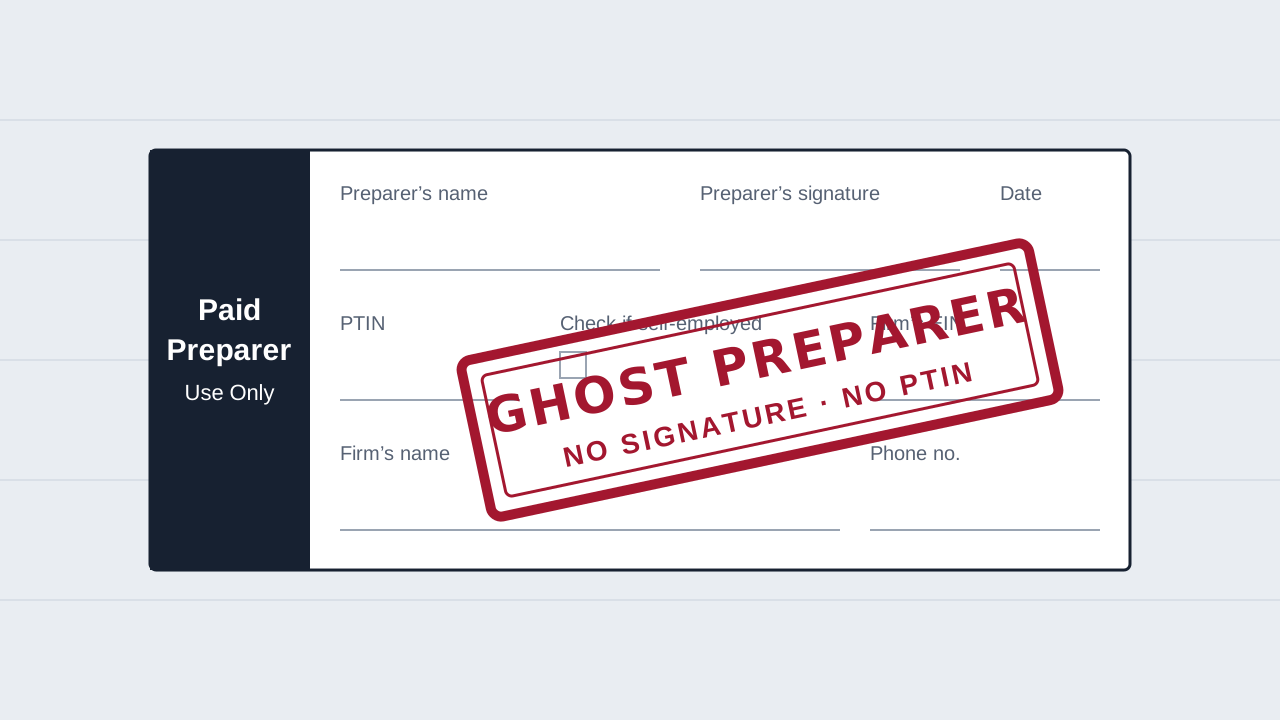
A withholding scheme, mostly uncredentialed. TIGTA identified 2,044 preparers who potentially promoted an overstated withholding scheme on 78,530 returns for Tax Years 2023 and 2024, requesting more than $740 million in refunds. The scheme reports income and withholding that third-party records don’t support, often from a made-up employer. About 84 percent of those preparers were uncredentialed. The number of preparers using the scheme on half or more of their returns nearly tripled from 2023 to 2024. Ghost preparers, who prepare returns but leave off their signature and PTIN, filed returns with the same pattern requesting about $179 million.
PTINs went to people who shouldn’t have them. Since 2010 the IRS issued or renewed 67 PTINs for people listed as deceased, and at least six prisoners prepared 371 returns with nearly $2.1 million in refunds while incarcerated. In a limited review, 691 IRS employees held active PTINs, and 92 may have prepared returns while employed, even though federal rules bar IRS employees from preparing returns for compensation, gift, or favor.
Limited authority, slow strategy. A 2013 court ruling (Loving v. IRS) limited the IRS’s power to set standards for uncredentialed preparers. TIGTA recommended a service-wide preparer strategy in 2018; as of June 2026 the IRS had begun drafting one. TIGTA made one recommendation, to finalize and implement that strategy, and the IRS agreed.
What it means for your clients
- The client owns the return. When a preparer inflates withholding or invents an employer, the IRS comes after the taxpayer for the tax, penalties, and interest. The preparer may be long gone.
- Frozen refunds are often the first sign. Returns claiming withholding that third-party records don’t support get flagged. A client chasing a “delayed” refund may be looking at an examination instead.
- A new client’s last preparer matters. An unsigned prior-year return, or one with no PTIN, is worth a closer look before you build a case on it.
- Credentials matter for representation. Only CPAs, enrolled agents, and attorneys have unlimited representation rights before the IRS. An uncredentialed preparer can’t stand between your client and collection.
What 21 Century Tax is not
- Not a ghost preparer. Every return we prepare for pay is signed, with an active PTIN, and the client gets a copy of what was filed.
- Not paid on the size of the refund. Fees are flat and scoped in writing before work begins. No contingent fees.
- Not uncredentialed representation. Clients are represented before the IRS only by practitioners authorized under Circular 230 and named on a Form 2848.
- Not a refund promise. We report what the records support. Withholding comes from the W-2s and 1099s, not from a write-in box.
- Not a blank page to sign. No client signs an incomplete return or an authorization they haven’t read.
Warning signs to share with clients
Drawn from TIGTA’s findings and the IRS’s own “Dirty Dozen” warnings. Any one of these is a reason to stop and get a second opinion.
- The preparer won’t sign the return or put a PTIN on it.
- The fee is a percentage of the refund, or the preparer promises a bigger refund than anyone else.
- The preparer suggests adding income, withholding, or an employer that doesn’t exist, or says the IRS won’t check.
- The client is asked to sign a blank or incomplete return.
- The refund goes to the preparer’s bank account instead of the client’s.
- The client never gets a copy of the return that was filed.
- The preparer offers to “handle” an IRS problem but isn’t a CPA, enrolled agent, or attorney.
Credentialed preparers and Annual Filing Season Program participants can be checked in the IRS Directory of Federal Tax Return Preparers with Credentials and Select Qualifications.
Next Step services that fit
- Second Look at Your Tax Return. A prior-year return from a questionable preparer reviewed line by line.
- Fix an IRS-Prepared or Incorrect Return. A return built on unsupported withholding or credits corrected before the IRS corrects it for you.
- Audit Representation. A credentialed representative when the flagged return turns into an examination.
- IRS Letter Response. Verification and adjustment letters answered correctly and on time.
- Penalty Removal. Relief requested where the client qualifies, documented the first time.
Source: Treasury Inspector General for Tax Administration, The IRS Must Do More to Address Noncompliance and Potential Misconduct With Return Preparers (October 21, 2026), Report No. 2027-IE-R001. Reports are available at tigta.gov.
This summary is for tax professionals and is general information, not tax or legal advice for a specific situation. Figures are as reported by TIGTA. Results for any client depend on their facts, documentation, and IRS discretion.